
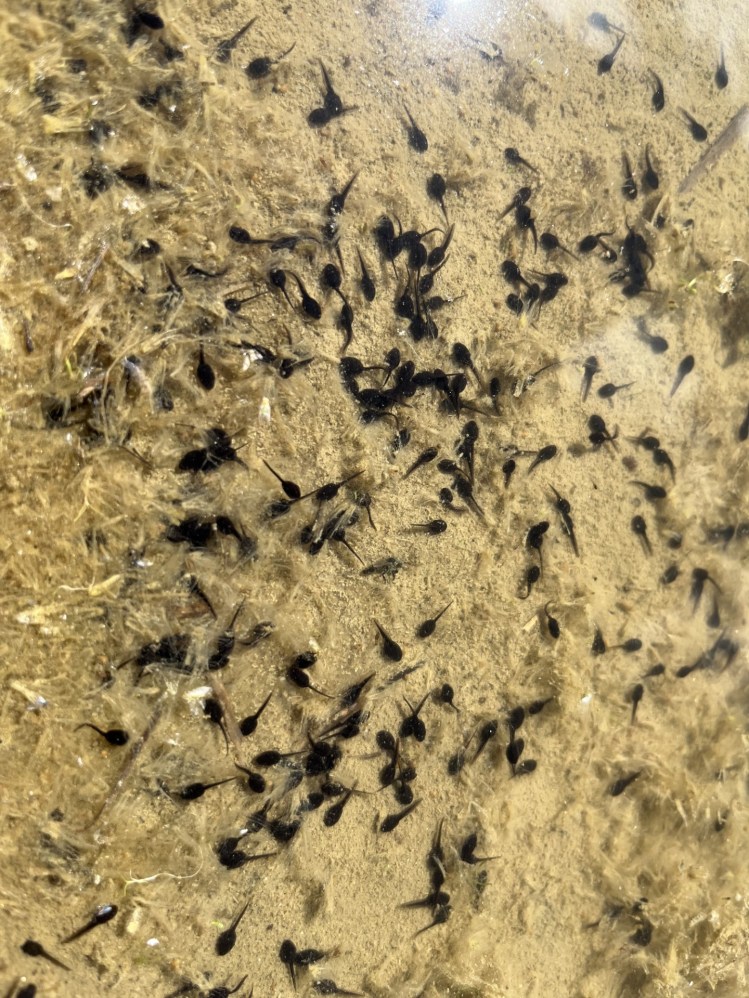
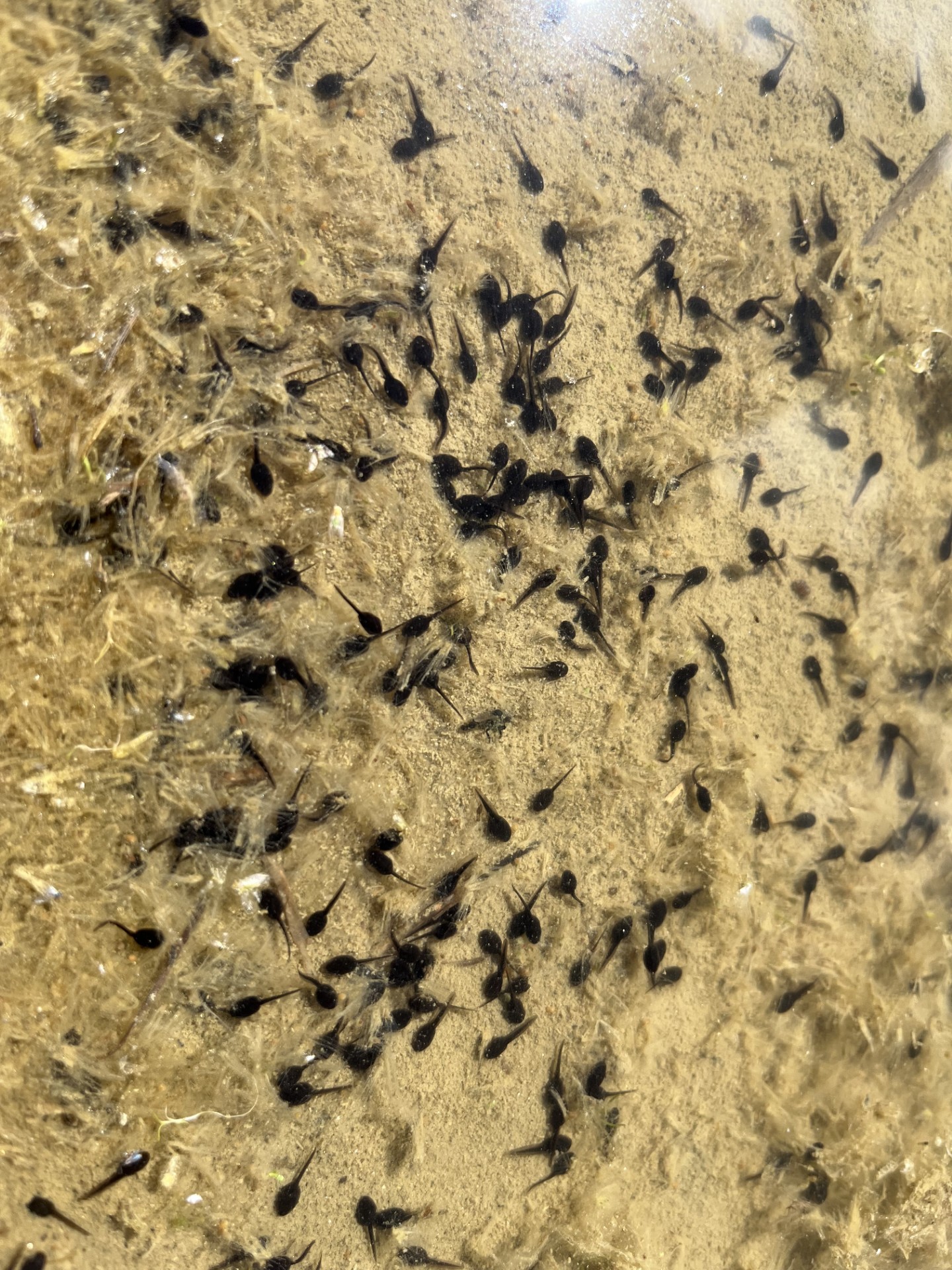
First there were tadpoles, then there were knot

Why an alternate collective noun should be a philosophy of tadpoles

A short personal essay about good intentions, unintended consequences and looking for meaning.

It happens every year. The perpetual(ish) puddle that my kids slide across on their bellies in winter and throw stones in during spring and autumn dries up in the summer. But not before some stubborn frogs lay a bunch of frogspawn in it. Many species return to the same place they spawned year after year, and apparently, common frogs can live upwards of seven years. Maybe they didn’t get the note about climate change and drier summers—still preferring to risk laying eggs in their familiar spots: ponds.

Now, I use the term pond loosely. What we’re really talking about is a divot in the ground on the edge of a quarry that routinely fills—or floods—with water. While I wouldn’t recommend messing around in active quarries, I’ve lived next door to this one for eight years. I walk around the edge with the dogs every day, so I’ve got a good sense of the land’s stability. Honestly, I’m not even sure how the place stays in business. Once every couple of months they seem to fire up the machines, but that’s about it.

We’ve collected tadpoles several times—feeding them dandelion leaves blanched in boiling water and dropped onto the surface of the tank. Once we have little froglets, we release them.

This year, we’re only just out of April showers and the pond is tiny. In my mind, this usually happens much later. While the water is often low and we often “rescue” tadpoles, I don’t think I’ve ever looked at it and thought, Hey, these guys are all doomed.

So I rallied/pestered/marshalled the kids into their wellies and we set off—two of us full of cold—with a large bucket and a scoop to rescue as many little wrigglers as we could.

It did not go according to plan.

The fine sandy soil around the edge of the puddle was like quicksand, spilling over our boots and working its way through any cracks. My son got stuck once by accident—and I mean really stuck. We had to use sticks to dig him out and rock the wellies back and forth. Then he got stuck twice more on purpose.

The water was so shallow that I had to scoop at a very shallow angle. If I moved too fast, I just got mud; too slow, and they wriggled away. The ripples from scooping also washed many up onto the mud, where they got stuck. I had to painstakingly pick them up or gently flick them back in.

The more I scooped and rescued, the lower the water level dropped. Then we had to carry—what I now realised was an excessively large 25L bucket—about 400 to 500 metres to the bottom of the quarry, where there’s a year-round pond. (Again, safety note: I know this quarry very well. I use the machine road and only did this when the quarry was closed.)

To replace the water we’d scooped out with the tadpoles, we carried a half-full bucket back up out of the quarry to refill the puddle.

We repeated the process again. But the more I tripped and fell at the edge of the puddle while rescuing tadpoles, the more the soggy quicksand ground shifted, distorting the puddle and stranding even more.

After the second load of tadpoles had been released—and we were covered toes to knees, fingers to elbows, and splattered everywhere in between—it was time to call it a day.

I felt bad walking away. But saving them all seemed impossible, because everything I did had unintended consequences. I tried to hold on to the image of all the tiny tadpoles swimming in the shallows of the pond at the bottom of the quarry, rather than those stranded on the mud, struggling to make it back into the water. We replenished the puddle one last time, hoping to give the others a bit more of a fighting chance. Then, with dripping noses and achy arms, we headed home.

The whole thing wouldn’t stop churning around in my head. It was like I had to make meaning out of it—learn a lesson, come to a conclusion. What an odd, overwhelming compulsion it is to assign meaning to an event.

Perhaps in caveman times or ancient Egypt, if I’d been contemplating this, I would have drawn a cave painting of wise tadpoles sent from above to teach me a lesson? Honestly, probably not. I’d be thinking about food. But throughout history, symbology and religion have assigned higher meaning to stories and events.

Now, I do believe in a God—but I also believe he’s a hands-off kind of guy. The nonsense we get up to is a result of our free will. If he kept stepping in, it would mean influencing people—and then free will wouldn’t exist. And what kind of test of character would that be? (Maybe he sends signs, but it’s still up to us to follow them.)

So as I pondered whether there was a deeper meaning, I also resisted the idea.

The next day, I missed my morning walk but went in the evening. The puddle was gone—completely churned up and destroyed by some of the quarry machinery during their bi-monthly parade.

Lesson?

There is no lesson. Just do good things—even if they’re hard—before the opportunity is gone.
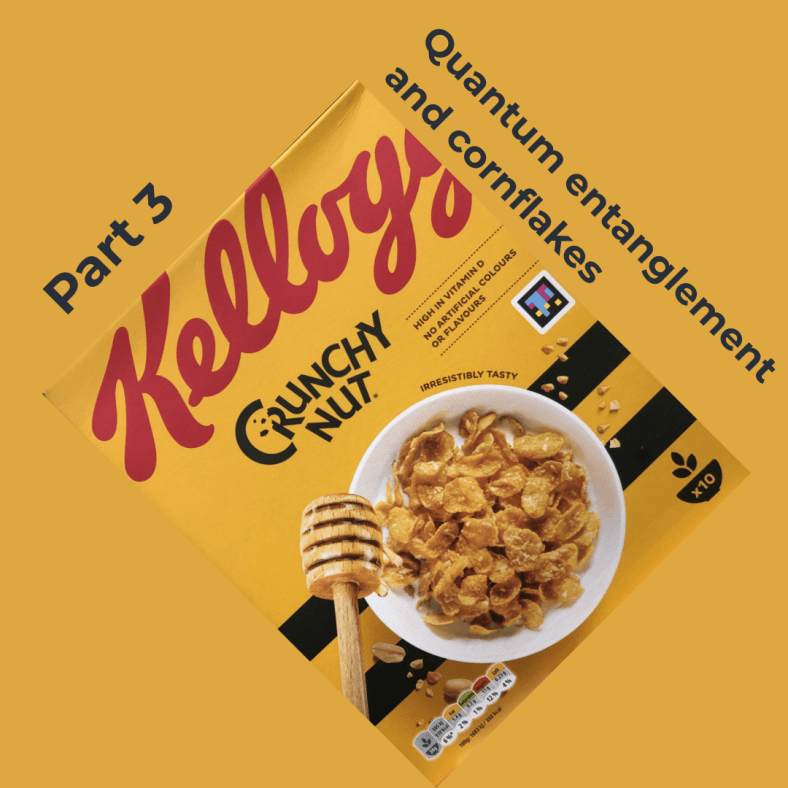
Quantum entanglement and cornflakes: Part 3

Of all the replies he’d imagined finding the next morning, none came close to the hurried scrawl that filled the front of the cereal box.

“Business trip, September, mum dies too, house on fire, trapped, SAVE YOURSELF”

He sat down heavily, unsure whether to view this particular message as comical or concerning. He imagined what would’ve happened had he read the message mid-sip: a cartoonish arc of coffee spraying from his mouth and his eyes popping from his head.

He shook himself and raised an eyebrow—perhaps it was just ominous language and fake foresight, like a fortune teller’s predictions. The business trip part was vague enough to be accurate in a number of circumstances, but her mum dying too…and a fire. Those parts seemed unnecessarily and worryingly specific.

Unsettled and late, he scribbled on the box “? I need more details” and as an afterthought, “Are you ok?”. He shoved the empty cornflake box back into the centre of the table next to the almost full one and hurried out to work, dropping the recycling on the curb as he went.

All day he sat with a notebook at his elbow projecting possible timelines “Grace died two weeks ago”, “business trip, September”, “lived here for 25 months”, “house on fire”. Despite the apparent simplicity of the task, he went over it again and again, until he was satisfied he had pinned down a danger window; the last two weeks of September and the first two weeks of October.

He left work early with a plan forming in his mind, all he needed was a few more details.

There was only one cereal box on the kitchen table when he got home. Frantically, he searched the bin, the recycling and the cupboards, nothing. He started texting Grace and Helena then stopped himself. It was over, the box was gone.

And yet it wasn’t over. Remembering the fire, he examined the table for ashes. He was slightly disappointed and relieved to find none, but then the spycam caught his eye.

He popped the SD card into his computer and played the last 24 hours of film at high speed, nothing. Helena normally dropped by to clean at around 10 am, it wasn’t her normal day but… he slowed the speed. As he watched, he realised the time stamps were jumping forward. Checking the settings, he realised that rather than motion-activated or continuous, he’d selected battery saving mode. Instead of video he had photos taken at 10-second intervals. Was 10 seconds enough for someone to run into the kitchen and leave a note or move a box without being seen?    

That night, he took his laptop to bed and fell asleep with tabs filled with searches for digital nomad jobs, rental villas, October holidays, and common causes of house fires, all crammed into his browser like sprinkles on a doughnut.

The next day he felt energised. He told Grace all about his plan for them to get away together in the autumn, for a whole month—to really reconnect with each other. He left off the part about it all being the result of cereal-box-induced fear of death.

In the coming months, he busied himself getting rid of candles, installing smoke alarms, sweeping the chimney, booking accommodation and flights and finding a fully remote job.

It was all organised, they would both be out of the country for the entire ‘risk period’. And if Grace never went on the business trip, her mum would also be safe. He did, however, arrange a long weekend with Grace’s parents before they left.

The day before the flight, Grace’s phone rang. He’d never seen her turn as white as when she took that call. Her mum had been rushed into intensive care following a stroke and wasn’t expected to survive the night.

There was still a choice, but it was a terrible one. Grace was unlikely to go on a business trip now, and if her mother died, maybe the cereal box was wrong. But he would still be in his house. Grace was in no state to drive, and so he climbed behind the wheel, deferring the decision to the morning.

A tense night turned into a week, then two weeks. Without ever making a conscious decision, they spent almost the entire risk period nursing her mother and helping her father around the house. As October rolled around, it seemed Grace was out of danger, though her mother was now battling pneumonia.  

On a grocery run for crunchy nut cornflakes of all things—he had a stockpile in the pantry at home—he got the call. “We lost her” was all Grace could manage to say. He hated that phrase.

In the coming days, he moved home to make space for grieving relatives. He was almost out of the woods, but given the circumstances, the whole thing now seemed absurd and delusional.

The day before the funeral, his phone lit up—Grace. In what he hoped was a sympathetic and reassuring voice he asked “How are you holding up?” there was a pause, then he heard her father’s voice, cracking and choking “I can’t believe I need to tell you this but we’ve lost her too” he went on to mumble something about the funeral still needing to go ahead and hung up. What else was there to say? The outcome hadn’t changed, just the specifics. In that moment, he made his peace and spent the evening drowning his sorrows.

Grace was inconsolable. Her mother’s death, the misplaced ashes, their eventual discovery—then this. For a long time, she couldn’t forgive herself for not calling him that night, but she’d been too upset to speak. She knew Mark had liked her mother. But to drink himself into a stupor—and remove the batteries from the smoke alarm? Some things were inexplicable. It seemed the fire had been started by an electrical fault in an old plug socket hidden at the back of the storage pantry where he kept his cereal.

The end